
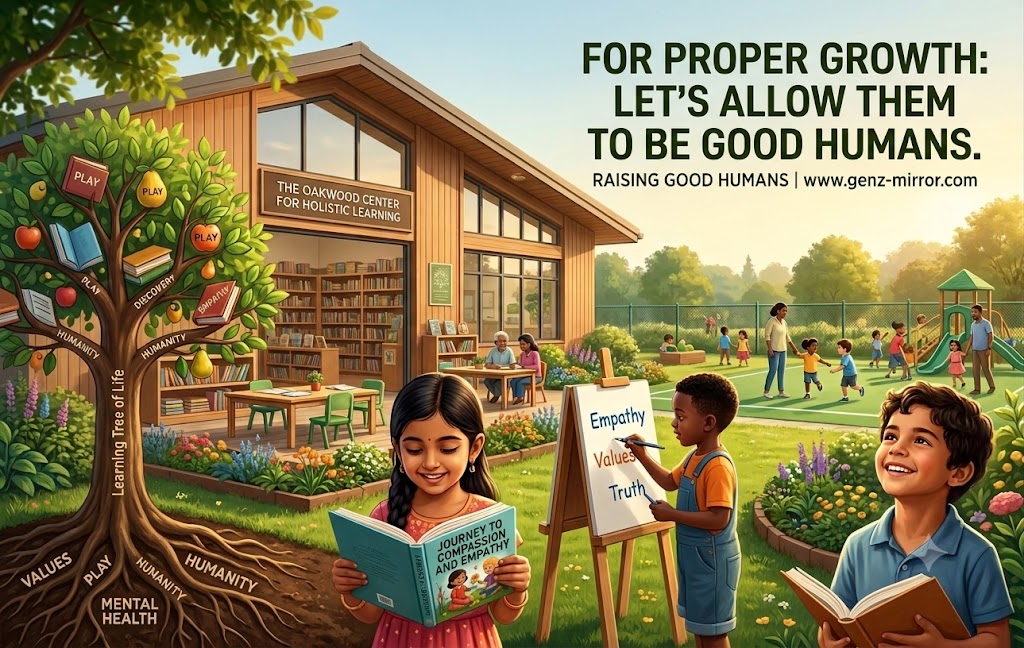
Beyond the Report Cards: Why Modern Classrooms Must Prioritize Human Values
Raising Good Humans: Future of Education 2026
This post addresses a critical global crisis: our modern education system prioritizes industrial corporate job training over building core human values. Inspired by a thought-provoking newspaper column from Aligarh Muslim University’s librarian, M.K. Asif, this article ( Raising Good Humans ) explores how schools have evolved into factory assembly lines. By over-focusing on academic grades, we are neglecting mental health, emotional resilience, and basic empathy. True education requires letting children play, explore open libraries, and develop organically. This international piece serves as a wake-up call for parents and educators worldwide to shift our collective focus from creating hyper-competitive workers to nurturing emotionally stable, deeply compassionate, and holistically grounded individuals.

Value-based child education, holistic student development, modern academic pressure, mental health in schools, parenting for empathy
20x Hashtags: #GenZMirror #MindfulParenting #HolisticEducation #RaisingGoodHumans #ChildMentalHealth #ValueBasedEducation #FutureOfLearning #EmpathyInEducation #SchoolLife #LetKidsPlay #MentalWellbeing #GlobalEducation #ModernParenting #CharacterBuilding #BeyondGrades #EdChat #HumanityFirst #ChildDevelopment #AlternativeEducation #NurturingTheFuture #Raising Good Humans
The contemporary world is experiencing an unprecedented paradox. While we boast higher global literacy rates than at any other point in human history, our societies are simultaneously fracturing under the weight of systemic intolerance, anxiety epidemics, and a collective decline in basic empathy. We are building smarter machines and higher skyscrapers, but are we building better people? The foundational purpose of education has drifted dangerously off course. Classrooms were originally conceived to be sanctuaries for the human soul—places where character was forged, and intellect was married to ethics. Today, they have largely transformed into high-pressure processing plants designed to manufacture compliant corporate cogs. It is time to break this cycle and return to an essential truth: the primary goal of schooling must be raising good humans.
The spark for this vital conversation stems from a poignant newspaper clipping penned by M.K. Asif, a librarian at the prestigious Aligarh Muslim University. His observation is beautifully simple yet deeply profound: most of the growing crises within our modern society do not stem from a lack of technical knowledge, but from a severe deficit in value-based education. He argues that if our schools simply provided children with an expansive, unrestricted playground to run in and a vast, inviting library to read in, the children would naturally acquire moral values and robust mental health on their own. Unfortunately, even when modern institutions possess these physical resources, they rarely utilize them correctly. Instead of allowing children to play when it is time to play and study when it is time to study, we force them into a hyper-accelerated race toward corporate employment.
To understand the depth of this issue, we must look at how children actually learn. Forcing an eight-year-old child to memorize abstract formulas at the expense of their playtime does not make them a genius; it systematically starves their emotional development. Play is not a luxury or a reward for good behavior; it is the fundamental biological mechanism through which young minds learn conflict resolution, emotional regulation, and deep empathy. When children navigate the unscripted social dynamics of a school playground, they learn how to share, how to cope with defeat, and how to stand up for others. By replacing this vital, organic socialization with endless test-preparation drills, we are inadvertently fostering an environment of isolation and ruthless competition.
Furthermore, the obsession with standardized testing has created a generation that views knowledge purely as a transactional tool. Students learn to memorize facts for an exam, only to immediately purge that information from their minds once the grading cycle concludes. This mechanical approach completely bypasses the emotional heart of learning. True wisdom is found in the quiet corners of an open library, where a child can pick up a book not because it is on a syllabus, but because it sparks their natural curiosity. Reading widely across diverse genres exposes young minds to varied human perspectives, cultivating a deep global awareness that no rigid textbook can ever replicate. We must encourage independent exploration to turn passive students into active thinkers.
This perspective aligns perfectly with the evolving global dialogue surrounding educational reform. Experts at organizations like the Center for Holistic Education emphasize that academic intelligence without emotional maturity is not only incomplete but can often become actively destructive to a community. History is filled with highly educated individuals who lacked the moral compass necessary to use their knowledge safely. When an educational framework values grades above character, it implicitly teaches children that their human worth is tied exclusively to their productivity. This toxic mindset is a direct driver of the skyrocketing rates of teenage anxiety, depression, and burnout that we observe globally today.
To counteract this, society must collectively redefine what a successful education looks like. A successful school should not be judged solely by the Ivy League admissions or high-paying corporate placements of its alumni. Instead, the true measure of an educational institution should be the kindness, integrity, and civic responsibility demonstrated by its graduates. We need to create spaces within our communities that actively celebrate emotional intelligence, artistic expression, and community service. Parents must also share this burden by shifting home conversations away from “What grade did you get today?” toward “How did you help someone today?” Changing the questions we ask our youth changes the priorities they establish for their lives.
This paradigm shift requires a structural overhaul of how teachers are trained and how curricula are designed worldwide. We must integrate mindfulness, ethical philosophy, and collaborative project-based learning into the core daily schedule. Rather than segregating “values” into a brief, dry weekly lecture, ethics should be interwoven into every subject. Science classes should discuss the moral responsibilities of technological innovation; history classes should analyze the human cost of systemic greed; literature classes should serve as deep analytical deep-dives into human empathy. By making moral reflection a constant, active element of intellectual development, we teach students that thinking deeply and caring deeply are inseparable actions.
As global citizens navigating an increasingly complex and interconnected world, we can no longer afford to ignore the emotional well-being of the next generation. The future of our global society does not depend on creating more ruthlessly efficient workers; it depends on nurturing deeply compassionate problem-solvers. We must actively support alternative learning structures and champion educational policies that view children as holistic individuals rather than statistical data points. Insights on the profound connection between early emotional freedom and long-term societal health can be further explored through resources provided by the Child Development Institute, which highlights the necessity of balanced upbringing.
Ultimately, the transformation of our education system begins with a simple, conscious choice by individual parents, educators, and community leaders. We must have the courage to slow down, step off the relentless academic treadmill, and give our children the breathing room they need to grow organically. Let them run on the playgrounds until they are tired; let them lose themselves in the pages of library books that expand their horizons; let them make mistakes and learn how to heal. By prioritizing character over commerce and empathy over elitism, we can gradually heal our fractured world from the ground up. Let us stop training children to be flawless, unfeeling machines, and instead dedicate our collective energy to the far more beautiful, urgent, and necessary task of raising truly good humans.

Share this post from www.ministarmart.com/ if you believe our world needs more empathy and less academic pressure. Let’s spread this message globally!


 No products in the cart.